unbarrier.voice
the audit that starts with the child and works backwards.
every readiness tool scores the organisation. unbarrier.voice measures the one thing they skip: whether the technology, the access and the communication actually reach the learner they were bought for.
device-agnostic. built on the learner’s own experience. it is the measurement layer under everything we do.
one pathway, not three products. voice is the layer the other two run on.
unbarrier.audit — a discovery day uses it to find the gaps.
unbarrier.access — a partnership year uses it to prove the movement between the start and the end.
unbarrier.voice — same seven questions, every time. it makes notice and embed into measurements rather than impressions.
what it asks — the seven questions
asked from the learner's side. pick any moment in a lesson, and ask all seven of it. that is the whole method. it needs no software, and it is the part with the most value in it.
- provision
- is there a device, a tool, a connection at all — and is it in the room, charged and working when the lesson starts?does the thing exist for this child, or only on the inventory?
- access
- can the child get into it without an adult beside them — the settings, the login, the support features?does it work for them, not just work?
- design
- was the material built with more than one way in, before anyone had to ask for an adjustment?universal design, and the only lever left where the law cannot reach.
- capability
- can the adults set it up on a tuesday, and does it hold across teachers, subjects and buildings when the champion is away?is this practice, or is it one person?
- belonging
- does the child want to be there, take part without being asked, and get back in when something goes wrong?access without belonging is attendance.
- trust
- do the child, the family and the staff believe it will work when it matters — and believe their data is safe?a tool that fails twice in front of a class is never opened again, whatever the audit says.
- evidence
- can you show a parent, a governor or an inspector what actually changed, without reaching for the word “engagement”?if it cannot be shown, it cannot be funded, defended, or done again.
take the seven questions with you
the seven questionsa4 · one side · free, no emailtwo ways to run it
delivered
nici in the room. an apple professional learning specialist watching what a survey cannot see: the workaround a learner has invented, the setting nobody turned on, the moment an adult steps in three seconds too early. learner data captured alongside it.
very few people can put an accessibility specialist in your classrooms for a day. that is where the value sits.
the £500 discovery day →the tool
self-serve. your own staff and learners complete it, and the picture builds itself. scalable across a trust, and it runs without anyone from unbarrier in the building.
the backbone.
founding cohorts →most schools use both: the tool for breadth, a delivered visit for depth.
what a baseline is
where you are now, scored against the seven questions. a starting number, not a verdict.
it is a baseline you can measure again later, so “impact” stops being a word and becomes a number you can stand behind.
in the cycle every piece of our work runs on — notice → design → try → embed — voice is what makes notice and embed into measurements rather than impressions. it is the same instrument at both ends, which is the only reason the difference between them means anything.
after the baseline
what you get back
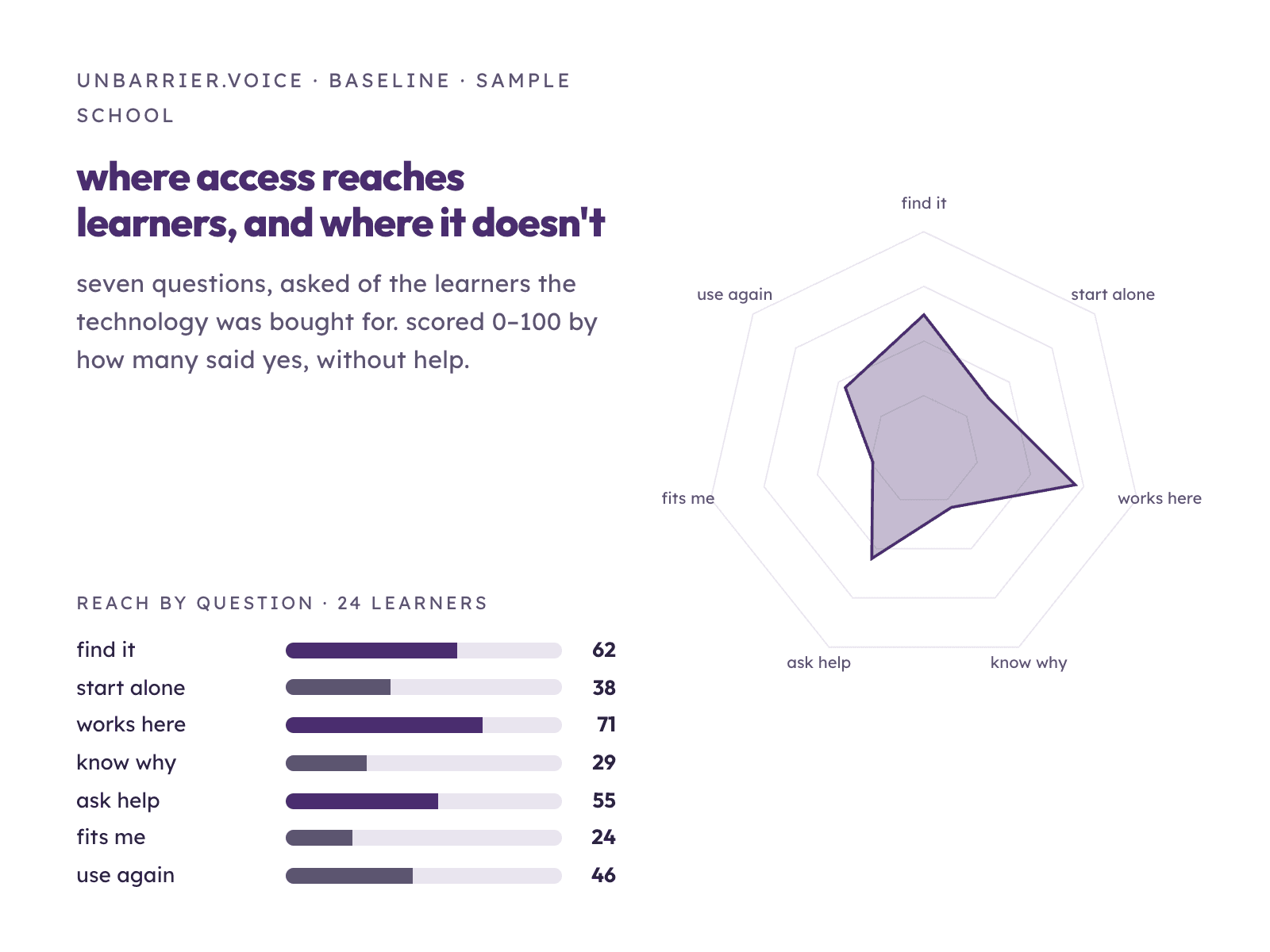
01
a one-page picture
where access is reaching learners, and where it isn’t.
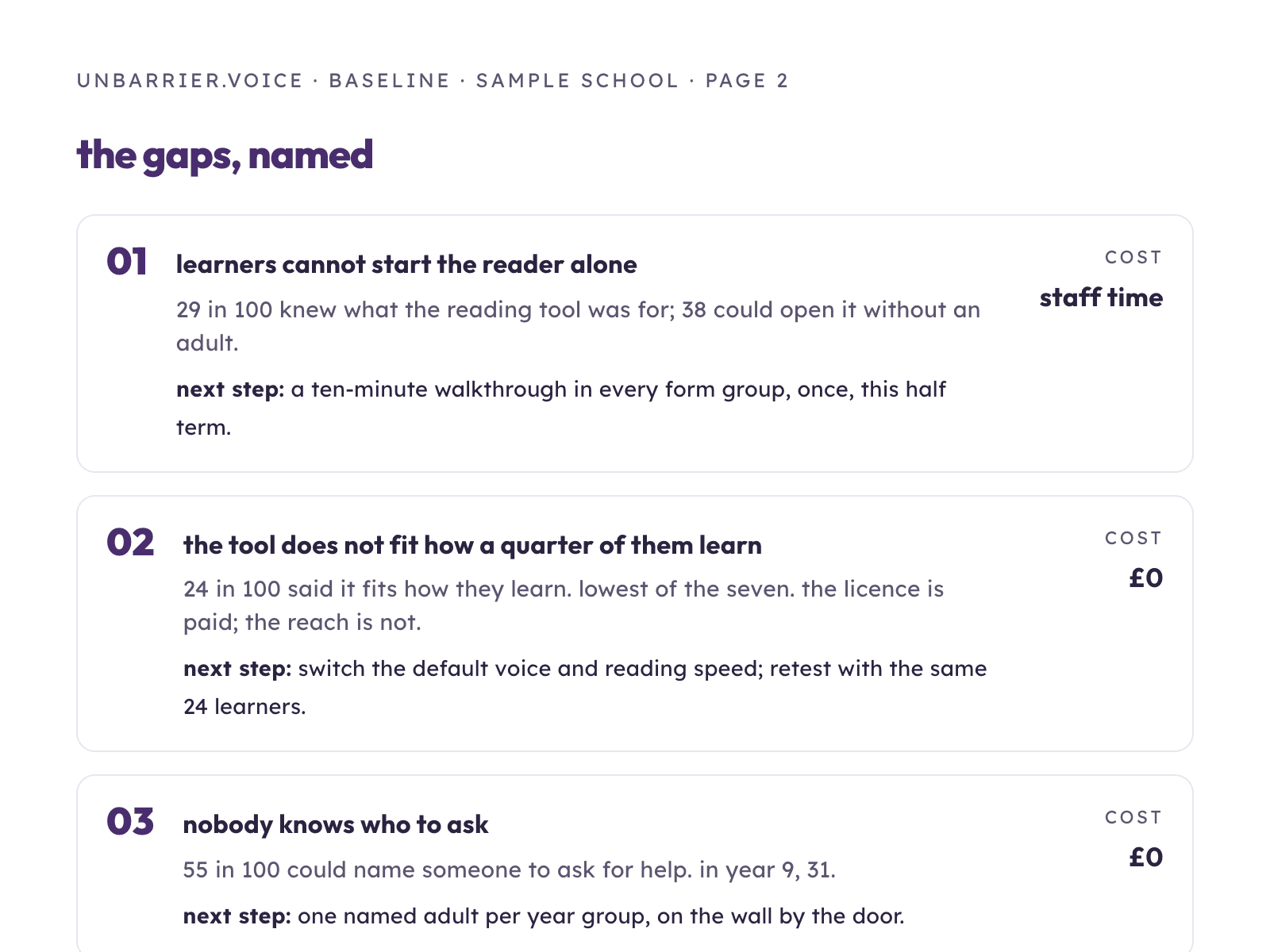
02
the gaps, named
in language a governor understands, so the spend can be defended and the next step funded.
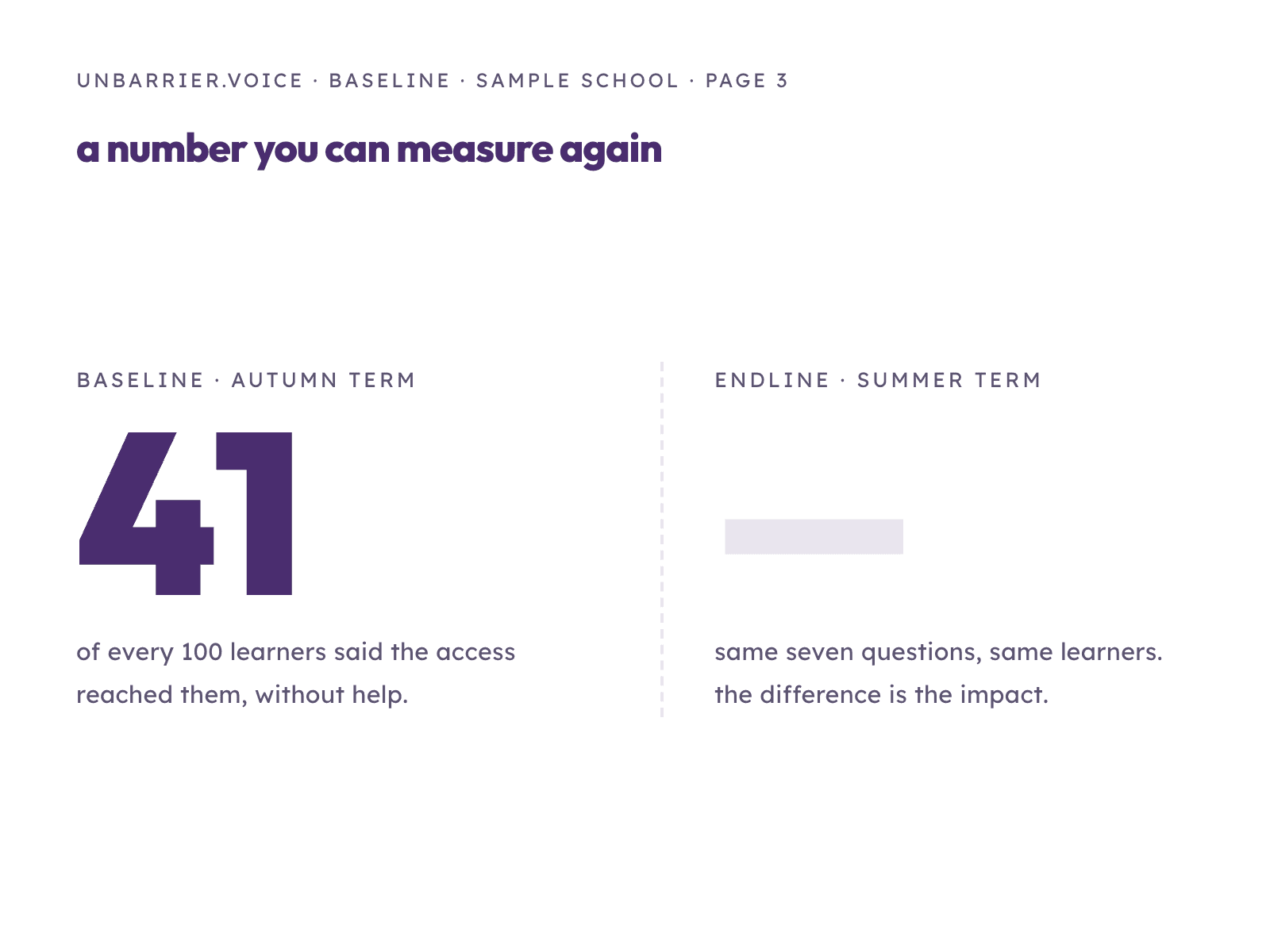
03
a number you can measure again
a baseline to return to, so “impact” becomes a number you can stand behind.
report pages shown are illustrative — sample data, not a real school.
two purposes, two consents. never bundled.
that isn’t a legal footnote. it is the whole point of an instrument built to be trusted.
delivered is available now. the tool is being built with the first schools who want it.
you can have the delivered version today. nici in your classrooms, observing what a survey cannot see, with learner data captured alongside it. that needs no software and it is the part with the most value in it.
the self-serve tool is being built with its first schools, not for them. we are looking for three founding cohorts. research runs this autumn and feeds directly into what the instrument asks and how it reports — so the schools who join now shape it around a real setting rather than an imagined one.
if that is you, tell us about your setting. no date promised, and nothing to pay.
we agree how you will know it worked, and when we will check.
that movement is your evidence. tell us what you’re working with. if we can help, we’ll say how. if we can’t, we’ll point you to someone who can.
notice
one email when there is something worth saying. nothing when there isn’t. written for people who don’t have time to read it twice.